



CRAFT STORY | EUROPE | UK | TEXTILES
The Wilton Technique: History and Innovation with Tim Page Carpets

Founded in 1992, Tim Page Carpets has established itself as one of the UK’s foremost names in bespoke floorcoverings. Working with highly skilled artisan weavers and tufters from across the globe, the brand is renowned for its mastery of hand-crafted rugs and carpets, championing traditional techniques through a lens of innovative design. More recently, this wealth of expertise has been harnessed to rediscover the quintessentially English Wilton technique, whose origins evoke a period of remarkable creative vitality—still discernible today in its intricate, romantic patterns.


The Wilton technique is one of the oldest and most prestigious methods of mechanically woven carpet production, its history deeply intertwined with that of England and the Industrial Revolution. Around 1740, in the town of Wilton, in the county of Wiltshire, the first attempts were made to replicate the refined qualities of Oriental carpets. While these were traditionally hand-knotted, the ambition was to employ emerging technologies to achieve a comparable effect using a cut pile. The result was carpets distinguished by a soft, even surface /reminiscent of velvet) yet remarkably durable.
During the Industrial Revolution, looms became increasingly advanced, and the entire region, long associated with the wool trade, emerged as a center of textile excellence. The prominence of the town of Wilton, which lent its name to the carpets, was the result of several strategic factors: the availability of skilled labor; the arrival of Flemish and French artisans – who brought new expertise and disseminated fresh stylistic ideas – and, finally, the support of the local aristocracy, which financed the earliest manufactories and attracted further specialist craftsmen.

The true innovation, however, lay in combining a robust ground fabric – constructed with a double warp and capable of accommodating intricate patterns, including floral and classical motifs – with a short pile, cut and woven into the base, thereby achieving both structural strength and refined aesthetic complexity.
Over time, the Wilton technique continued to evolve, enabling the use of multiple colours simultaneously and the creation of ever more intricate designs. These proved immediately popular among the affluent classes, placing Wilton carpets in direct competition with two other prestigious types: Brussels carpets (earlier in origin, though less opulent in appearance) and Axminster carpets, which came later and, while capable of greater decorative intricacy, were less compact in structure.


To this day, Wilton carpets are regarded as the finest among machine-made floorcoverings. It is precisely for this reason that Tim Page Carpets and Jean Monro have chosen to revisit and celebrate this tradition through their collaboration. “Iconic fabrics translated into floorcoverings” was the guiding concept behind the five designs, all realised in 100% wool and available as both rugs and wall-to-wall carpets.
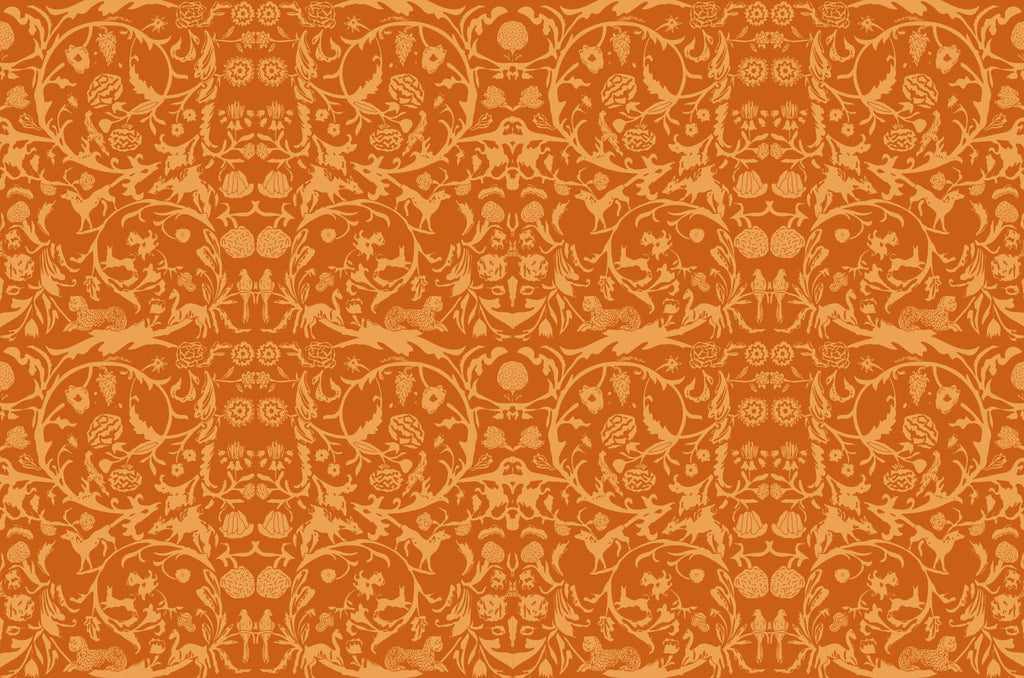
Viewed as a whole, the collection possesses an unmistakably romantic sensibility: the palette is soft, almost powdery, and imbued with a charmingly pastoral character. There is a revival of chintz – most notably in the “Hydrangea and Roses in Coffee Fawn”, adapted from an 1840s block-printed design – alongside vibrant, joyous “Auricula”, and trailing branches of fruit with broad leaves inspired by traditional English harvest motifs in “Gooseberry in Lettuce”.

Words by Sara Pierdona
Images from Tim Page Carpets
EXPLORE THE ATLAS